




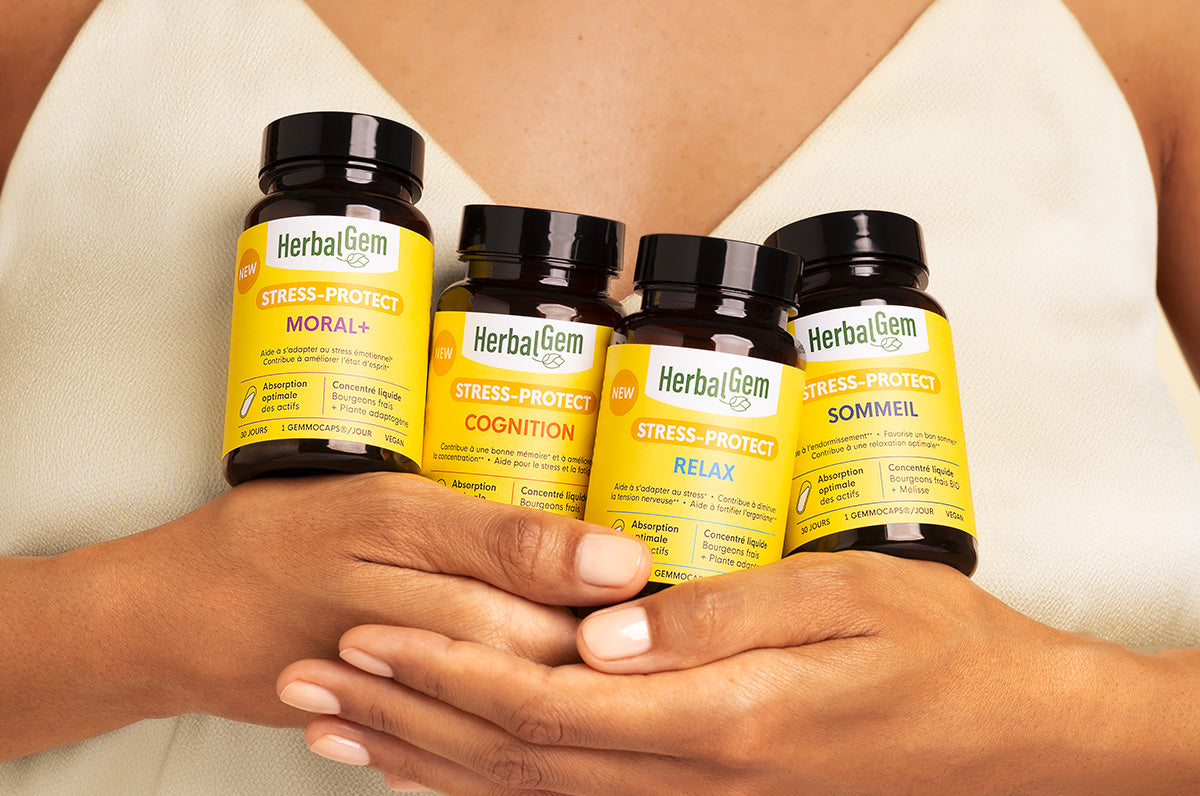


Sleep becomes fragmented, breathing grows shorter, the mind keeps going over the same thoughts. When anxiety settles in, it occupies the background of every day, well beyond the uncomfortable moments before speaking in public. Natural solutions have a precise role here: bringing the body back to a more stable state while the pressure is gradually eased. Gemmotherapy is one of these approaches. It works with Buds, the embryo of the plant, and it is the founding field of HerbalGem, a pioneer in gemmotherapy. This guide explains what happens in lasting anxiety, how to recognise it, and which natural solutions genuinely help you regain calm.
Anxiety or chronic stress: what are we talking about?
The two words are often used together and partly overlap, but they do not describe the same thing. Stress is a response to an identified situation. Anxiety keeps running once the situation is over, or even before it happens.
What sets anxiety apart from passing stress
Occasional stress serves a purpose: it mobilises energy, sharpens attention, then subsides once the deadline is behind you. A tense meeting, an unexpected event, an exam. The body then returns to its point of balance.
Anxiety works differently. Worry remains present without a clearly defined object, often focused on what might happen. It feeds on repeated exposure to the same sources of tension, and the body no longer goes through the recovery phase. This is what is called chronic stress: vigilance never fully comes down, and the two states end up sustaining each other.
The term generalised anxiety refers to the stage where this worry becomes permanent and detaches from any specific trigger: it moves from health to work, loved ones or money, changing its focus without ever stopping. This diagnosis belongs to the doctor, who alone can make it. What follows applies to everyday anxiety, and as a complement to existing medical follow-up, never as a replacement.
Cortisol, when tension no longer comes down
Cortisol is produced by the adrenal glands, two small glands sitting above the kidneys. Its release triggers a series of reactions designed to prepare a rapid response: muscles contract, heart rate and breathing speed up, blood is redirected to the limbs, and digestion takes a back seat.
Over a few hours, this mechanism is harmless, it is even designed for this. The problem comes from its duration. When production stays high week after week, the overall balance shifts: sleep, digestion, natural defences and memory all pay part of the price.
Recognising anxiety that is settling in
It shows in the body before it can be put into words. Spotting these signals early changes what comes next, because a body that is still holding up responds better than one that is already exhausted.
Signals from the body
- Broken sleep: taking a long time to fall asleep, waking during the night, nights that are not restful
- Tiredness that persists even after eight hours of sleep
- Muscle tension in the neck, shoulders and upper back
- Disrupted digestion: bloating, a knotted stomach, irregular transit
- Headaches that are more frequent and more persistent
- Palpitations, the feeling of a racing heart without physical effort
- More reactive skin, flare-ups of acne or eczema
- Lower natural defences, with winter infections that linger
Chest sensations are often more worrying than the others, and understandably so: tightness in the middle of the chest, a pinching point under the breastbone, breathing that stays stuck high up. Most of the time they come from tension in the intercostal muscles and from shallow breathing, two direct effects of prolonged tension. But no chest pain should be self-diagnosed: a first occurrence, a pain that lasts or that spreads to the arm and jaw justify calling the emergency services (112 in Europe) without waiting to find out whether stress is involved.
What the mind feels
- An underlying worry, present without any identifiable reason
- Irritability over minor annoyances
- A loss of drive, including for things that used to bring pleasure
- Difficulty concentrating and unusual forgetfulness, a topic covered in our selection dedicated to memory and concentration support
- A gradual withdrawal from outings and group activities
When prolonged anxiety weighs on the body
Continuous pressure leaves measurable traces. Blood pressure and heart rate stay high for longer than they should. Natural defences weaken, which explains repeated colds and inflammation that settles in, particularly on the skin, in the respiratory tract and in the joints. Hormonal balance is also disrupted, with weight changes and blood sugar that is harder to regulate.
Beyond a certain stage, support from a health professional is no longer one option among others. A doctor, a psychologist or a sophrologist have tools that no course can replace, and gemmotherapy sits alongside this follow-up, never in its place.
Plants and Buds that bring back calm
Three families come together when looking for natural options: food supplements, phytotherapy, then gemmotherapy. Phytotherapy uses the mature plant or one of its parts, leaf, flower or root. Gemmotherapy starts from an earlier point, the Bud, harvested in spring just before it opens.
This stage has a property that explains everything else: the Bud already contains everything the adult plant will become, and it is rich in active compounds that the mature plant no longer concentrates to the same degree. Hence a course measured in drops rather than cups. Concentrated Bud extracts are taken orally, never applied to the skin.
Fig tree, the Bud for relaxation
Fig tree is the Bud people turn to first when anxiety has set in. It acts on the central nervous system: the mind calms down, thoughts stop going round in circles, and sleep becomes possible again.
Its second feature plays out lower down. Anxiety often reaches the stomach, with that knotted feeling that nothing on the food side explains. Fig tree works on this precise link between the head and the gut, which makes it the Bud for anxious people with poor digestion.
Why Blackcurrant Bud helps you cope
Blackcurrant Bud meets another need. It supports the adrenal glands, the very glands that produce cortisol, and it is classed among adaptogens, plants that help the body adjust to prolonged pressure.
In practice, it restores energy to a body that has been drawing on its reserves for too long. It is the Bud for evenings when nothing is left, and the one that limits the slide towards exhaustion.
Lime tree and Hawthorn Buds for restless nights
Lime tree is the Bud for sleep and nervousness. It calms evening agitation, the kind that prevents sleep even though the body is tired, and it suits people who wake at 3 in the morning with their mind already racing.
Hawthorn is for moments when emotion is felt right into the chest, with the impression of a heart beating too hard or too fast. It brings calm in this area and combines well with Lime tree on difficult nights. Our range of natural solutions for stress and sleep brings these different options together.
Should several Buds be combined?
Yes, several Buds can be combined, up to 3 single Buds, when their properties are complementary. The combination then makes it possible to meet several needs within the same routine. For example, Fig tree can be combined with Blackcurrant when the aim is to act on both the nervous system and vitality.
No Bud is "stronger" than another: each has its own properties and is chosen according to the need. Combining several Buds should therefore remain consistent and targeted, rather than multiplying products.
To choose well, it is best to start from the main need and identify the Buds that can complement each other.
The combination of Fig tree and Blackcurrant is particularly relevant when tension sets in over time. When sleep difficulties take up a large place, Lime tree can complete this combination. For those who prefer not to measure out several bottles, combinations of several Buds are already dosed together.
Breathing, movement, sleep: the foundation for regaining calm
No course can make up for lifestyle habits that sustain anxiety. These habits cost nothing and their effect is felt within a few days.
Breathing to break the loop
Cardiac coherence is the most documented technique and the simplest to adopt: six breaths per minute, five seconds breathing in and five breathing out, for five minutes, three times a day. Heart rate becomes more regular, and the feeling of tightness in the chest clearly decreases after two weeks of daily practice.
Abdominal breathing does the same job in urgent moments, when tension rises suddenly. One hand on the stomach, the in-breath expanding the lower ribs rather than the shoulders, the out-breath twice as long.
At the peak, allow two minutes, no more: four seconds breathing in through the nose, six to eight seconds breathing out through the mouth, repeated ten times. The lengthened out-breath does the work, because it is the only voluntary lever on the parasympathetic nervous system, the one associated with rest. A hand resting on the stomach is enough to check that the air goes all the way down.
Olfaction complements these exercises well. Two drops of true lavender essential oil on the inside of the wrists, breathed in slowly, mark a clear pause in a high-pressure day.
Moving, eating, sleeping
Thirty minutes of brisk walking three times a week is enough to make a difference: physical activity releases endorphins and lowers the level of nervous tension. Intensive sport in the evening, on the other hand, delays falling asleep.
On the food side, two adjustments matter more than the others. Meals at regular times, because drops in blood sugar amplify the feeling of anxiety. And a last coffee before 2 pm, as caffeine remains active in the body for six to eight hours.
Sleep is worked on through timing above all: getting up at a fixed time, even at weekends, a bedroom at around 18 degrees, and screens switched off an hour before bed. When these adjustments are not enough, food supplements for better sleep can take over.
Acting on the underlying causes: moving away from what sustains anxiety
The most common reflex is to pile up relaxation techniques without changing anything at the source. This does not hold over time. Start by listing what fuels the anxiety, situation by situation, then look at what can change:
- Leaving a job that has become unbearable, or renegotiating its scope
- Setting clear limits in a relationship that is draining
- Prioritising requests and refusing those that go too far
- Delegating what does not need to be done by you
When the source cannot be removed, there remains the work on distance. A large part of the burden comes from the meaning we give to events rather than from the events themselves. Stepping back reduces the body's reaction, and this is exactly the area where a therapist or a sophrologist is most useful.
Dosage, course duration and precautions
Gemmotherapy should not be improvised, even if it is gentle. Here is how to use it.
- Dosage: 5 to 15 drops a day per Bud, diluted in a glass of water
- Timing: preferably away from meals, in the morning for Blackcurrant, in the evening for Lime tree
- Route: oral only, Buds are not applied to the skin
- Duration: a 3-week course, followed by a one-week break before starting again
Certain precautions should be taken into account depending on the Bud and each person's situation. During pregnancy or breastfeeding, when following medical treatment or in the case of a specific health condition, it is recommended to seek advice from a health professional before using a food supplement.
The duration of use may also vary depending on the Bud, the product and the need. A course is generally part of a regular approach, alongside suitable lifestyle habits. It is best to follow the recommendations on the product and to check with a health professional if discomfort persists or worsens.